Showing posts with label leadership effectiveness. Show all posts

Monday, August 1, 2011

Have You Fallen Prey to the Seven Signs of a Bad Boss?

It's tough for employees to be engaged and focused on attaining key organizational and professional goals when they are under the influence of an ineffective manager or supervisor. 

And, the quickest way to ensure high labor turnover within your department as soon as the job market improves is to demonstrate the characteristics of a BAD BOSS.

  1. Bad Bosses Have No Clear Goals. If your team has no clue of the goals or expectations they should be working towards, this may be a weak area for you. In such cases, that there are either no goals at all; the goals are unrealistic; or they are unclear to the team. This leads your team to believe that either their boss doesn’t know what they are doing, doesn’t care, or doesn’t want them to be in the loop.
  2. Bad Bosses Deliver Poor or No Communication. These are the silent types, who revel in their team not knowing what they are thinking. Bad Bosses don’t feel it necessary to communicate how the company is doing, nor how employees are performing in their jobs. They just don’t communicate, and rarely show any emotion – good or bad.
  3. Bad Bosses Hold No One Accountable. When there is no communication of team standards or goals, Bad Bosses really can’t hold anyone accountable for excellence or even mediocre job performance. Bad Bosses are apt turn a blind eye, allowing rampant compromise throughout the workplace – and in spite of their lack of accountability, they are not approachable and some employees even fear them.
  4. Bad Bosses Often Blames Others. When things don’t go as they planned or expected, Bad Bosses are quick to point fingers at everyone except themselves – especially when their team doesn’t perform up to par. While self-accountability is out of the question, Bad Bosses find it easy to blame inefficient work systems, processes, and staff members (all within their sphere of control) for their inability to meet company-wide goals and performance standards.
  5. Bad Bosses Have No Strategy for Improvement or Team Success. Stubbornly believing that strategizing is a waste of time, they just don’t bother with it. Bad Bosses have a false belief that they are doing fine as is; and because often the powers that be (senior leaders and board members) don’t hold them accountable for positive change, things remain in a constant state of confusion for both customers and employees.
  6. Bad Bosses Never Delegate. To mask their fear of employee empowerment, Bad Bosses fail to properly train and delegate challenging tasks to their team members. They are cynical when it comes to their team, and don’t feel that anyone has the intellect or capacity to perform their job satisfactorily. Therefore, the team remains stagnant and virtually paralyzed in the absence of leadership.
  7. Bad Bosses Don’t Mentor Others. To them training, development of staff, and mentoring is also a waste of time. They often say, “No one ever mentored or developed me and I turned out alright.” Bad Bosses have no concept of how to synergistically collaborate with their team to help them grow and excel in their jobs. Unfortunately, Bad Bosses practice “tough love” when it comes to on-the-job training.
Now take a minute and assess your current workplace. How many of these poor leadership behaviors do you or your leaders regularly exhibit? When you are treated like this, how does it make you feel?
If this information has helped you surfaced some of your blind spots, now is a good time to make a change in order to increase your effectiveness as a leader. And for more information on how to enhance your effectiveness as a leader, check out our popular book "The Leadership Book of Numbers, Volume 1"

Friday, July 1, 2011

Looking for Fresh, Creative Ways to Drive Service Excellence?

Performance Solutions by Design is one of the few premier consulting firms that not only offer keynote presentations, webinars, online workshops, and training for leaders and line staff -- we also offer a host of comprehensive Service Excellence Tools and Resources.

Click the link http://tinyurl.com/6la6g7fto check out our latest library of Service Excellence Tools and Resources, and learn how you can take advantage of deep discounts when purchasing the package we are featuring this month.  You are guaranteed to find something that you can use...

Friday, June 10, 2011

Do You Possess the Six C's of Leadership?

There are Six C's of Leadership that anyone who has influence and power over a team of people should possess.

Having the ability to master these six characteristics is the embodiment of a highly effective and successful leader.

  1. COMPETENCE - more than knowing "how to do" something, but also displayed in the level of confidence, finesse and effectiveness with which it is done.
  2. COMPASSION - the balance of kindness and empathy.
  3. COURAGE - doing what is right, even when it is unpopular.
  4. CHARISMA - a positive energy and an enthusiasm that inspires others to change.
  5. COMMITMENT - best demonstrated in the level of dedication and allegiance you have toward your team.
  6. COMMUNICATION - the ability to share information in a clear and concise manner so that everyone understands.
Which of these Six C's of Leadership are your strengths? Which are oportunities for improvement? What will be your plan for personal change?

In the final analysis, becoming a person of influence that others want to follow begins with YOU.  Remember, exceptional leaders are competent, committed to the cause, courageous, great communicators, charismatic, and possess a great deal of compassion for others.

To read more on the Six C's of Leadership and other short tips for leaders on the go, check out our latest book, The Leadership Book of Numbers, Volume 1.  We guarantee it will help you grow your business, enhance your professional life, and lead others more effectively. 

Sunday, March 13, 2011

The Power of a Service Excellence Sustainability Plan

After attending our one-day session “The Leadership Toolkit for Creating and Sustaining a Culture of Service Excellence” most participants leave with a renewed sense of self-motivation and accountability for driving excellence.

However, without the proper tools and resources to elevate customer service to the next level many leaders allow their work environments to slowly revert back into the same old ineffective, non-customer centric mode.

Creating a Service Excellence Sustainability Plan not only helps leaders identify gaps that may be standing in the way of their team performing at optimal levels and providing exceptional customer service, but it also helps them put in proper perspective how they will overcome barriers to achieving and sustaining a high level of excellence.

A sound Service Excellence Sustainability Plan will assess whether or not the leader needs to refine the team’s: (1) Telephone Etiquette Standards to ensure the customer’s first impression when calling in is a positive one; (2) Grooming and Appearance Standards so that the first visual impression that a customer perceives is always a positive representation of the company; (3) Communication Processes so there is total alignment within the team and across departments; (4) Problem Resolution and Empowerment Processes so that if a customer experiences a problem it is dealt with effectively, with a sense of urgency that retains customer loyalty; and (5) Recognition Systems that reward team members who consistently go above and beyond to provide an exceptional experience for every customer.

Now you may be thinking to yourself, “Is that it?” Of course not, but it’s a great start. These are the building block of proper customer service and when consistently done can lead (over time) to a 20-30% increase in customer satisfaction and profit.  Remember, creating a culture of service excellence is a journey, not a destination – and soon after closing these simple customer service gaps the highly effective leader will quickly move on to overcoming more significant barriers.

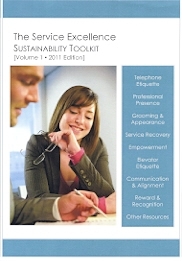
If you have established that simple service basics like telephone etiquette, problem resolution and empowerment, grooming and appearance, and internal communications need to be addressed within your team – our Service Excellence Sustainability Toolkit is a comprehensive resource guide that will help you close these gaps in a matter of days, not months or years.

Click the link   http://tinyurl.com/49fqwxm  to learn more about the Service Excellence Sustainability Toolkit and how you can obtain a copy. We wish you the best in your endeavor to drive excellence!

Thursday, January 6, 2011

8 Reasons to Focus on Service Excellence in the New Year

Creating a culture of Service Excellence is a journey, not a destination; and as we approach the New Year it’s a great time to reflect on what you actually accomplished and wish you could have accomplished in the past year.

If one of your organizational goals is to maintain a competitive edge by enhancing the customer experience, then focusing on Service Excellence could provide  a comprehensive approach that could result in service, product, and profit dominance.


Focusing on Service Excellence will positively impact:

  1. Organizational Alignment, by forcing you to refine your organization’s definition of exceptional service. Defining service excellence starts with clarifying what exceptional customer service should look, sound, and feel like every time a customer interacts with your staff or uses your products and services.
  2. Employee Engagement, by forcing you to involve employees in the planning of work that affects them. Creating a culture of service excellence is something that you do with employees, not to them. Their buy-in, commitment, and active involvement all contribute to sustaining the culture for the long-term.
  3. Leadership Effectiveness, by forcing you to hold leaders accountable for driving excellence. No longer will leaders be allowed compromise in the quality and level of service that their staff provides. Their performance will be directly linked to sustained employee engagement, customer loyalty, quality management, and profitability.
  4. Overall Communication, by forcing you to increase interaction with employees through regular updates on company issues that impact their work and in soliciting their feedback on ways to improve products and services.
  5. Operational Excellence, by forcing you to assess service and product quality gaps, then searching for and implementing simplistic, cost-effective ways to improve without compromising the customer experience.
  6. Service Recovery, by forcing you to identify ways to effectively resolve the most common customer issues through process improvement and teaching employees how to handle customer issues with a high level of professionalism and finesse.
  7. Customer Loyalty, by forcing you to create a customer-centered work environment that enhances all key touch points that make up the customer experience. This includes improving the way we greet and interact with customers; the way we answer the telephone; the manner in which we improve processes that directly impact the customer; and our process for resolving any issues that may arise and diminish the customer experience.
  8. Revenue & Profitability, by forcing you to focus on a more comprehensive approach to customer service by identifying ways to create an environment that fosters service, performance, and operational excellence. Ultimately, you create a delightful customer experience that makes them more apt to recommend your products and services, continue to return, and be willing to spend more.

While these eight reasons to focus on Service Excellence may not be all inclusive, my hope is that it has ignited creative juices as you think about how you will approach creating and sustaining a culture of Service Excellence in the New Year.


Wednesday, December 1, 2010

My Pleasure! Fostering a Culture of Gratitude

Many years ago when I worked for Ritz-Carlton Hotels, we had a signature phrase that every employee from the CEO to the Dishwasher used, it was “My Pleasure.” This phrase was genuinely used whether you were interacting with a guest, customer, or fellow employee; it was our unique way of saying “thank you”, we value your presence and are delighted to serve you.

As a Ritz-Carlton employee we were constantly reminded to use phrases like “thank you”, “I’ll be happy to”, “Certainly”, and “My Pleasure” – and words like “ok”, “yeah”, “gotcha”, and “no problem” were never used in the work environment.

Being ladies and gentlemen of The Ritz-Carlton organization, this was our way of fostering a culture of gratitude, while creating a warm, refined, yet relaxed ambience. And, we were constantly reminded by leadership that every employee is important, and should be treated with the highest level of dignity and respect. This feeling or culture permeated throughout the work environment and significantly enhanced employee engagement.

Assessing Your Organization’s Culture
Now take a moment to reflect on your team and work environment. What culture is being fostered? When your employees interact with customers or each other -- are they gracious, courteous, patient, and respectful? Or, are they impatient, abrupt, and often rude for no particular reason? Like it or not, often employees are a mirror image of their leader. Whatever behaviors the leader consistently demonstrates will be acted out by their employees with customers and each other.

Initial Steps in Creating the Culture
If you desire to create a culture of gratitude, you start by: (1) Treating every individual you encounter (whether they are a paying customer, employee, or peer) with the highest level of dignity and respect; (2) Never let your ego or professionalism come into question, even when dealing with difficult situations; and (3) Consistently use the type of refined vocabulary, words, and phrases that you expect your employees to use.

Now I don’t expect you to adopt Ritz-Carlton verbiage standards, but what I would highly recommend is that you quietly reflect on your work environment, determine appropriate verbiage, start using it, and integrate it into employee training so that it becomes second nature for your team.

In closing, I am not advocating that all you have to do is change the verbiage used within your organization to change the culture, but believe me it is a good start that will steadily move you in the right direction.

Wednesday, October 13, 2010

Building the Next Generation of Leaders

Performance Solutions by Design has a comprehensive library of over 60 FREE e-Learning Workshops that are designed to increase business acumen and leadership effectiveness. 

Whether you are considered a high potential employee, a mid-manager, or an emerging executive -- we have interesting and dynamic topics that will be of interest to you. 

Click here for details on our FREE E-Learning Workshops

Our seasoned workshop facilitators can also offer most of these topics in an engaging half-day or full-day leadership session at your location. We certainly hope you view and enjoy the learning. And, most of all please share this FREE information with your friends and colleagues.

Tuesday, August 10, 2010

Lessons Learned from Undercover Boss

If you haven’t been watching the reality show Undercover Boss, I definitely recommend you catch at least one episode soon. It airs weekly on CBS, and I’ve accidently caught 2 or 3 episodes over the summer months and they were well worth 60 minutes of my time.

For those not familiar with the show, it features a senior executive (typically the CEO) of a well-known corporation who works undercover in their own firm for a few days to investigate how the company really works and to identify how it can be improved. At the end of each show, the undercover boss resumes his true identity and summons the employees he worked with individually to corporate headquarters. He then reveals his identity and rewards the hardworking employees through promotions and financial rewards.

The reason I believe its worth one viewing (of any episode) by a leader is because it reveals the many blind spots senior leaders sometime have concerning their company and the effectiveness of new initiatives they firmly believe in and put in place system-wide. So, here are a few of my lessons learned:

 
Don’t get too caught up in smelling your own perfume or cologne. Sometimes we get so caught up in the financial outcomes of new initiatives and technology that we forget about or neglect the human element – our employees and customers.

Learn by walking around. Make it a habit to get out to your office at least a few times a year, visit the various departments and facilities, walk around, meet and greet employees, and genuinely ask for their input on how things are going. Most of all be prepared to hear the bad sprinkled in with the good to give you a firsthand impression of what the company culture really is.

Always make a good-faith effort to solicit employee input. Before implementing major changes or initiatives that will significantly impact how work gets done, request employee suggestions and feedback. This will not only prevent you from being caught off guard you when you hear that they are unhappy or dissatisfied with new changes, but also allow you to understand how the changes will impact them personally.

 
What I get most out of watching Undercover Boss is how detached we sometimes are (as leaders) from the day-to-day operations of our organizations, just how detrimental that can be to employee productivity and morale, and the immense sense of pride employees display when we show that we appreciate and value their contribution.

 
If you’ve been following the show (Undercover Boss), I would love to hear your impression of it, and whether or not you too have gained any lessons learned from it. I look forward to hearing from you!

Tuesday, February 9, 2010

The Purpose Driven Leader

Leaders of organizations are multi-dimensional.  Some are great at launching and building the business, others are great at sustaining a successful and financially viable business, and some are even adept when it comes to gracefully shutting down a business following a bankruptcy, merger or acquisition.

Regardless of where you fit in the leadership spectrum, the most memorable, endearing leaders are principle-centered, value-centered, others-focused, and driven by a strong sense of purpose. Recently we spent time with a CEO of a prominent health care organization, his actions and behaviors inspired me to define what it means to be a purpose driven leader.

Characteristics of a Purpose Driven Leader

Taking into consideration that at a minimum, all purpose driven leaders are highly competent in their field of work, there are ten key characteristics that set them apart from other leaders.

  1. They are customer and employee focused. Purpose driven leaders understand that it takes engaged employees to create loyal customers.  Therefore, they put tremendous focus on creating an environment that helps all key stakeholders thrive.
  2. They are people and process driven. Purpose driven leaders understand that you lead people, and manage processes; they know that both are vital in creating a culture of service, performance, and operational excellence.
  3. They are principle and value centered. Purpose driven leaders are guided by honesty, integrity, respect for all, passion for what they do, and excellence in everything they do.
  4. They have a strong sense of humility. It’s not about them; it’s about positively moving the organization forward. Purpose driven leaders have no problem putting their egos aside, in spite of their level of power.
  5. They are open-minded, lifelong learners. Purpose driven leaders don’t pretend to know it all; they revel in the fact that there is always more to learn to enhance their effectiveness.
  6. They are revered by their staff. People follow purpose driven leaders not just because of who they are in the chain of command, but also because of what they represent.
  7. They are not afraid to admit failure. If it’s for the greater good, purpose driven leaders are not intimidated by failure, it only motivates them to more readily regroup and continue the good fight in achieving and sustaining organizational success.
  8. They have a compelling vision. Purpose driven leaders regularly explain their vision for the organization with great clarity, inspiring the team to readily contribute to organizational success.
  9. They are happy people. Purpose driven leaders have a positive outlook, and are approachable by all. Even if they’ve had a bad day, just got out of an upsetting board meeting, or just got off of the telephone with a livid customer, they don’t carry bad attitudes on their sleeves.
  10. They never give up. Purpose driven leaders are tenacious, and continually in the pursuit of what is good and right for the organization, its customers, and employees.
While my list of key characteristics of a purpose driven leaders are not all inclusive, my hope is that it has inspired you to re-evaluate your leadership style, determine areas where you currently fall short, and commit to an action plan that will move you in the right direction. Why? Because as a purpose driven leader, I am sure you wouldn’t have it any other way.

Thursday, October 1, 2009

4 Reasons Managers Don't Empower

By definition, employee empowerment is giving your staff the freedom to make decisions without the authority of a manager, after they have been properly trained. Make no mistake, abdicating responsibility to employees because you are too busy, too lazy, or too important to do it yourself is not empowerment – that’s what we call “dumping”.

While true employee empowerment comes with many valuable benefits, few leaders use it as a means of raising the bar and driving excellence within their team. So, why don’t managers empower their employees? Well there are four fundamental reasons:

1. They are too busy. Too often managers are so involved in “doing the work”, that they lose sight of the fact that they may very well have a team of talented employees who can perform those duties with just a little coaching and direction – freeing you up to be the visionary leader you aspire to be.

2. They think it takes too much time. Many managers feel that in the time it takes them to train an employee on a new task, they could have very well taken care of it themselves. Unfortunately, this is short-sided thinking because your employees “never learn to fish” this way, and must continually interrupt you for insignificant matters that they should be capable of resolving on their own.

3. They think it’s too risky. Some managers are fearful their employees will make costly mistakes; in essence these managers are unwilling and afraid to take the risk. They don’t want to suffer the consequences of a poorly executed decision, even if it is a valuable learning experience for the employee.

4. They are secretly intimidated. Some managers question, “what if the employee makes a decision that makes them look smarter than me?” These type managers don’t want to arouse any movers or shakers within the department; thus, mediocre to marginal employee performance is just fine and the most they get out of the team.

So, if you have noticed that your boss rarely empowers you to make decisions or delegates challenging tasks to you, there may be an underlying reason. On the other hand, if you are the boss who rarely empowers the staff to handle routine issues within the department, you might identify with our top four reasons outlined above.

Bottom-line, creating and sustaining a culture of excellence cannot be achieved without fully engaged employees who feel a part of the organization, and feel that they are truly valued contributors to the success of the organization. For tips and coaching strategies for properly empowering your team, effectively delegating new tasks, and gaining back your valuable time, check out some of the best practices we have posted on our website.

Delegation, Empowerment & Time Management http://psbydesign.com/images/articles/TimeManagementJuly09.pdf

Cultivating Employee Empowerment
http://psbydesign.com/images/articles/PSBD_Newsletter_Oct08.pdf